
Situation
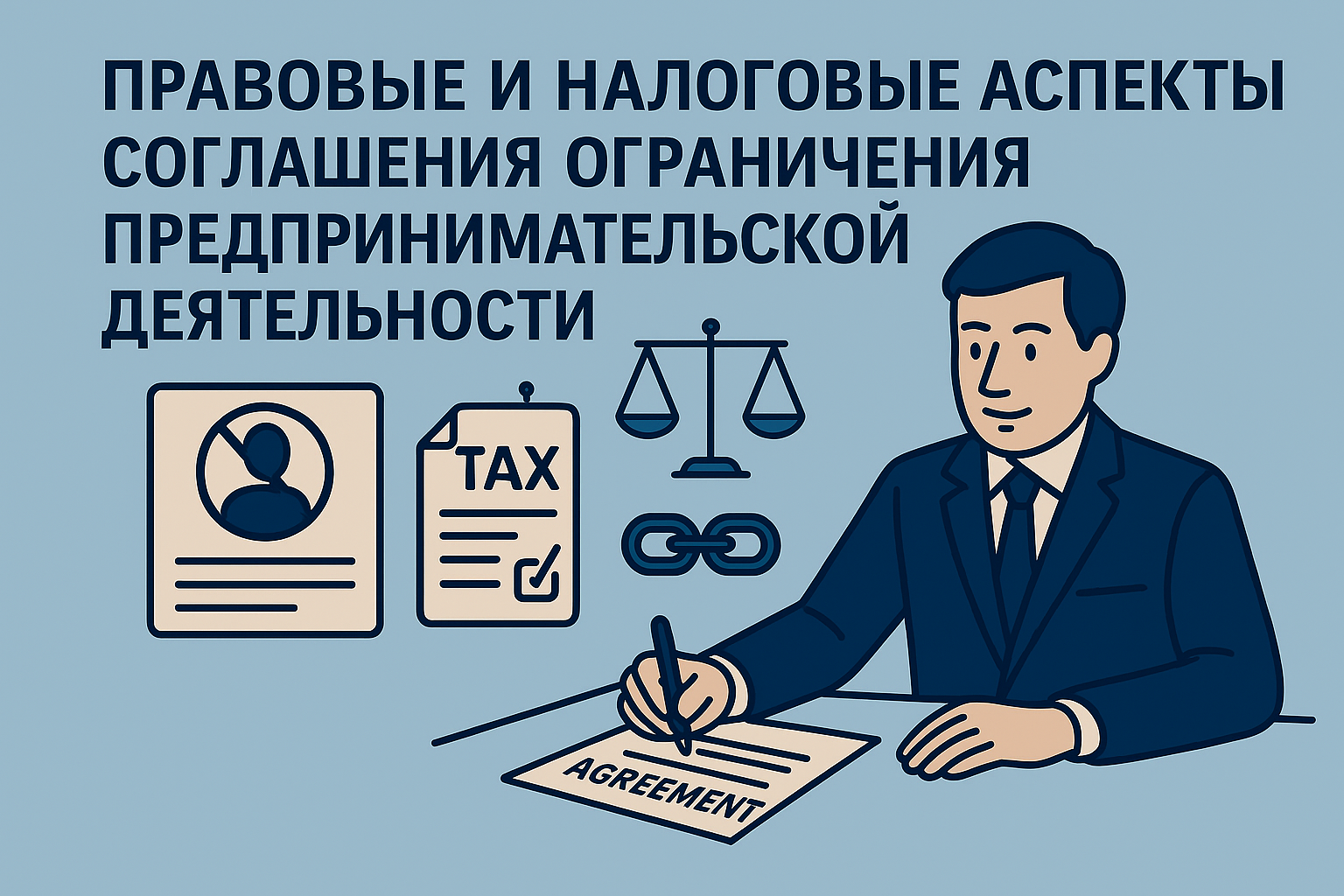
Market situations often arise where one market participant acquires not only another participant's assets but also pays additional compensation for consent to restrict business activities in a specific segment. Let's examine key legal and tax aspects of such agreements using a typical transportation industry example.
Initial Data:
An individual owns two companies with specialized equipment on their balance sheets. An independent third company holding a significant market share (over 50%) proposes acquiring part of the assets from one of the individual's companies. Besides paying market price for assets, the buyer agrees to pay additional compensation directly to the individual for consenting to restrict their company's business activities in a specific market segment.
Question 1: Can an individual's consent to restrict company business activities be formalized for compensation?
Answer:
Yes, such an agreement can be legally formalized. According to Article 2 of Kazakhstan's Entrepreneurial Code, entrepreneurial activity includes service provision. Consent to restrict business activities can be qualified as a service under Article 683 of Kazakhstan's Civil Code, where one party undertakes to perform certain actions while the other party undertakes to pay for this.
This position is confirmed by Kazakhstan's Tax Code, where subparagraph 6) of paragraph 2 of Article 372 states that for VAT purposes, consent to restrict business activities relates to work and service realization turnover.
It's important to note that individuals aren't required to register as individual entrepreneurs to receive such compensation if buyers fulfill tax agent obligations during payment (subparagraph 1) of paragraph 3 of Article 35 of the Entrepreneurial Code).
Question 2: Is there a standard form agreement for business activity restrictions?
Answer:
Kazakhstan legislation doesn't provide mandatory or standard forms for such agreements. We recommend developing contracts guided by general provisions on paid service agreements, considering specific situation specifics.
Agreements should clearly define:
- Subject matter (specific description of restricted activities)
- Restriction duration
- Territory where restrictions apply
- Compensation amount and payment procedure
- Party liability for agreement violation
Question 3: Is the concept of business activity restriction consent legally established?
Answer:
In Kazakhstani legislation, the concept of "consent to restrict or cease business activities" appears rarely, mainly in tax legislation:
- In subparagraph 6) of paragraph 2 of Tax Code Article 372 - as part of work and service realization turnover description
- In subparagraph 4) of paragraph 2 of Tax Code Article 378 - when determining work and service realization locations
- In subparagraph 1) of paragraph 7 of Tax Code Article 381 - regarding turnover determination procedures for such contracts
- In tax reporting form 110.00 (line 110.00.007)
This concept practically doesn't appear in other regulatory acts governing business activities.
Question 4: Do unfair competition or antitrust regulation risks arise in such transactions?
Answer:
Asset sale transactions and business activity restriction agreements must be considered from antitrust legislation perspectives. If buyers significantly increase their market shares as results, transactions may be qualified as economic concentration under subparagraph 3) of paragraph 1 of Entrepreneurial Code Article 201.
In such cases, obtaining preliminary antitrust authority consent is required.
It's important to note that business activity restriction agreements themselves aren't anticompetitive agreements under Entrepreneurial Code Articles 169, 170, 174, and 177 if they accompany legitimate asset purchase transactions and don't contain additional restrictions not directly related to main transaction subjects.
Question 5: What taxes apply to individual compensation for business activity restriction consent?
Answer:
Answer: Individual compensation for business activity restriction consent is subject to the following taxes and payments:
- Personal income tax (IIT) - 10% according to Tax Code Article 320. Tax is withheld and transferred by paying parties as tax agents.
- Mandatory social health insurance (MSHI) contributions - 2% according to paragraph 1 of MSHI Law Article 28. Since business activity restriction agreements are civil-legal contracts, income from them is subject to MSHI contributions.
It's important to note that maximum MSHI contribution calculation objects are limited to 10 times minimum wage (paragraph 3 of MSHI Law Article 29).
Mandatory pension contributions (MPC) don't apply, since according to subparagraph 2) of paragraph 2 of Social Code Article 248, MPC is paid by persons receiving income under civil-legal contracts for work performance (service provision). In this case, individuals don't actually perform work or provide services in traditional senses.
Question 6: Are there court disputes on similar issues?
Answer:
Public sources of Kazakhstan judicial practice lack precedents for tax dispute reviews related to compensation for business activity restriction consent.
Regarding antitrust regulation, judicial practice exists for cases involving failure to obtain antitrust authority consent for economic concentration. Therefore, it's important to comply with requirements for obtaining antitrust authority consent if transactions lead to economic concentration.
Conclusion
Compensated business activity restriction agreements are legitimate business tools when legislative requirements are met. Key aspects for safe transaction structuring include:
- Correct legal formalization
- Economic transaction and compensation amount justification
- Obtaining antitrust authority consent when necessary
- Tax requirement compliance
With competent approaches, such agreements can be effective tools for regulating market relations and ensuring market participant interest balance.
Gabitzhan Kudaibergen, Managing Partner at GK and Partners